Pin Up Deposit FAQ
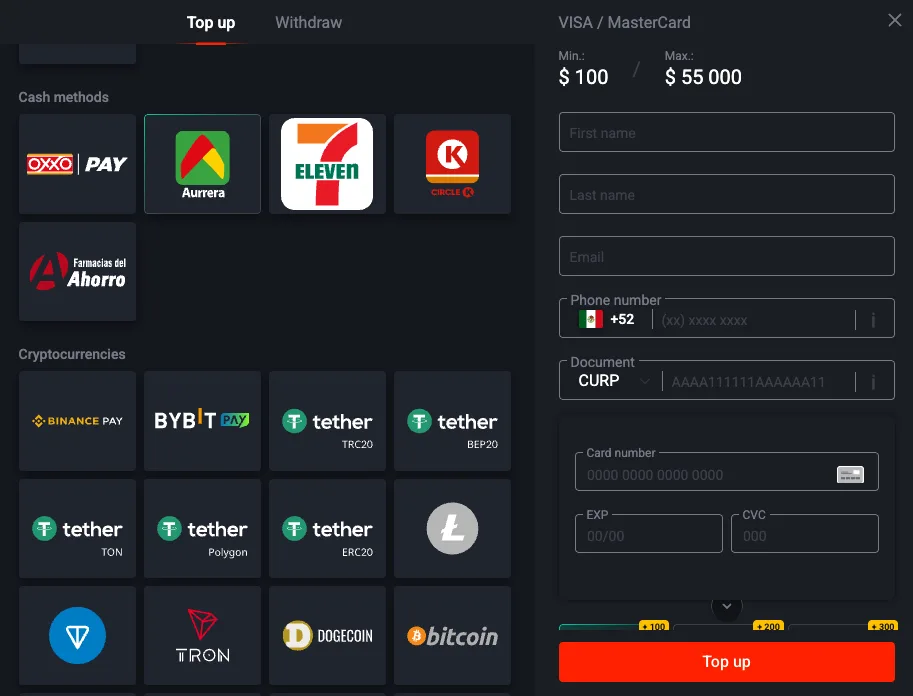 Screenshot context: real Pin Up cashier screen used for the faq guide, showing the payment-method area readers need to check.

Marcus Cole25 direct answers from the ex-bookmaker desk | April 2026
25 common questions about Pin Up deposits, grouped into five categories. Direct answers based on my 47-deposit test batch. If your question is not here, ping @marcuscole_bets on Twitter and I will add it to the next refresh.
Minimum & Maximum
What is the minimum deposit on Pin Up?
₹300 via UPI for Indian players, R$ 30 via Pix for Brazilian players, $10 via crypto globally. Cards minimum is $10 equivalent (~₹800). Bank transfer is $100. UPI and Pix are the cheapest paths with zero fees on both sides.
What is the maximum deposit?
Cards $5,000 per transaction, e-wallets $5,000, UPI ₹2,00,000 (your bank's daily cap may be lower), Pix R$ 10,000, crypto $50,000, bank transfer $100,000+ with VIP approval.
Can I deposit less than the minimum?
No. The cashier rejects below-minimum amounts with an error message. The minimum is enforced at the Pin Up level before the payment is attempted.
Why is the card minimum higher than UPI?
Card processors charge fixed per-transaction fees regardless of amount. Below ₹800 those fixed costs become unprofitable, so Pin Up sets the card floor at ₹800. UPI has no per-transaction cost, so the floor is ₹300.
Can I split a large deposit across methods?
Yes. Daily totals stack across methods. A VIP user can deposit $5,000 via card + $5,000 via Skrill + $50,000 via USDT TRC20 in one day legally.
Speed & Timing
How long does a deposit take?
UPI 38 seconds average, Pix 12 seconds, USDT TRC20 45 seconds, cards 2-5 minutes, BTC 23 minutes, ETH 5 minutes, LTC 12 minutes, bank transfer 1-5 business days. Pin Up is fast — the bottleneck is the payment network, not Pin Up.
Which method is fastest end-to-end?
Pix at 9-16 seconds is the fastest deposit rail in the entire Pin Up network. Nothing else comes close. UPI is second at 28-47 seconds. USDT TRC20 is the fastest global option at 45 seconds.
Why is BTC slow?
Pin Up requires 2 BTC confirmations and BTC blocks average 10 minutes each. Plus transaction propagation and Pin Up's internal processing, total ETA is 23 minutes on average.
Does the speed depend on my bank?
Yes for cards and Pix. Nubank Pix is 9 seconds, Bradesco Pix is 16 seconds. HDFC Visa is instant after 3DS, SBI Visa is declined entirely. Your bank's processing speed is often the limiting factor.
Can I track a pending deposit?
Yes. UPI deposits show in your bank app immediately with a reference number. Pix shows in your bank's Pix history. Crypto transactions are visible on the blockchain explorer (TRONScan, Etherscan, blockchain.com). Cards show on your bank statement.
Fees
Is UPI really fee-free?
Yes, verified across 12 test deposits. Zero fees from Pin Up, zero fees from UPI, zero FX spread because INR settles directly into Pin Up's INR wallet. This is the one method where "fee-free" is unambiguously true.
Is Pix really fee-free?
Yes, verified across 8 test deposits. Pix is regulated by BCB as a fee-free consumer rail and Pin Up does not charge on top. R$ 500 left my bank and R$ 500 landed in my Pin Up BRL wallet on every test.
Does Pin Up charge FX spread on cards?
Pin Up itself does not charge. The card processor applies 1.8-2.5% FX spread when converting INR/BRL to EUR/USD. I measured 2.12% on my HDFC Visa INR-to-EUR test. Hidden cost, not a line item.
What is the BTC network fee?
Around $2.80 average during moderate mempool congestion. Can spike to $10 during peak. LTC is cheaper at $0.12. USDT TRC20 is $1.10 flat. Pin Up does not charge crypto network fees — they go to the blockchain.
What is the cheapest deposit method?
UPI in India or Pix in Brazil (both genuinely ₹0 / R$ 0). Then LTC at $0.12 network fee, TRX at $0.20, USDT TRC20 at $1.10. Everything else is more expensive.
Crypto Specifics
Does Pin Up accept USDT on BEP20?
No. Pin Up accepts USDT on TRC20 and ERC20 only. Sending BEP20 USDT to a TRC20 or ERC20 address results in lost funds requiring manual recovery that takes 2-6 weeks and is not guaranteed.
What happens if I send crypto to the wrong network?
Funds may be permanently lost. The transaction exists on the blockchain you sent to, but Pin Up cannot credit it because their wallet is on a different chain. Open a support ticket with the transaction hash for manual recovery — success is not guaranteed.
Which crypto is cheapest?
LTC at $0.12 network fee. TRX at $0.20. USDT TRC20 at $1.10. BTC is $2.80 (variable). ETH is $3.40 (variable). LTC is the most underrated crypto method.
How many confirmations does Pin Up require?
TRC20 and TRX: 1 confirmation. BTC and LTC: 2 confirmations. ETH and ERC20 tokens: 12 confirmations. Confirmation requirements are set by Pin Up based on each chain's security characteristics.
Can I deposit from Binance directly?
Yes. Binance supports withdrawals to Pin Up's deposit addresses on TRC20, ERC20, BTC, LTC, TRX. Always select the correct network in Binance's withdrawal screen.
Bonuses & Verification
How do I claim the 120% bonus?
Deposit at least $10 equivalent on your first deposit. The bonus is automatically credited unless you uncheck the bonus checkbox on the deposit screen. You can also decline and claim on a later deposit.
What is the wagering requirement?
50x the bonus amount. On a ₹12,000 bonus (from a ₹10,000 deposit) that is ₹6,00,000 in total wagering. Slots contribute 100%, live dealer 10%, table games 5-10%.
What documents are needed for KYC?
Government ID front and back, proof of address dated within 3 months, and sometimes a selfie holding the ID. Upload clear photos under 5 MB each. No glare, corners visible.
How long does KYC take?
24-72 hours for clean submissions. Longer if documents are unclear or you are from a flagged jurisdiction. Submit during Pin Up's business hours for faster review.
Can I withdraw before clearing the bonus?
Yes. Your real money balance is always withdrawable. The bonus balance is locked until wagering is complete. Withdrawing the real money balance does not affect the deposit itself.
How to use this FAQ without getting lost
This page works best as a decision page, not just a dump of answers. If your question is “what should I use during reviewed sessions,” start with fees and timing, because that usually narrows the field faster than anything else. If your question is “why did my deposit behave strangely,” jump straight to speed, card declines, and crypto network questions. If your question is “should I attach the welcome bonus,” read the verification and wagering block before depositing, not after.
The pattern I see most often is that players come here asking about method speed, but the real problem is hidden cost or compliance friction. A card may be fast when it works and still be the wrong choice because of FX spread or issuer blocks. Crypto may be flexible and still be the wrong choice if you are not comfortable checking networks carefully. FAQ pages only become useful when they help you choose, not just memorize facts. That is the standard I am trying to hit here.
Marcus Cole
Marcus Cole is a sports betting analyst with eight years of experience and a background as a former bookmaker.
Reviewed by Sarah Mitchell — Senior Editor
High-Intent Deposit Guides
These supporting pages target narrow searches where users need a specific answer before they register, deposit, withdraw, or play. They strengthen the topical cluster without duplicating the main guide.
